
 By admin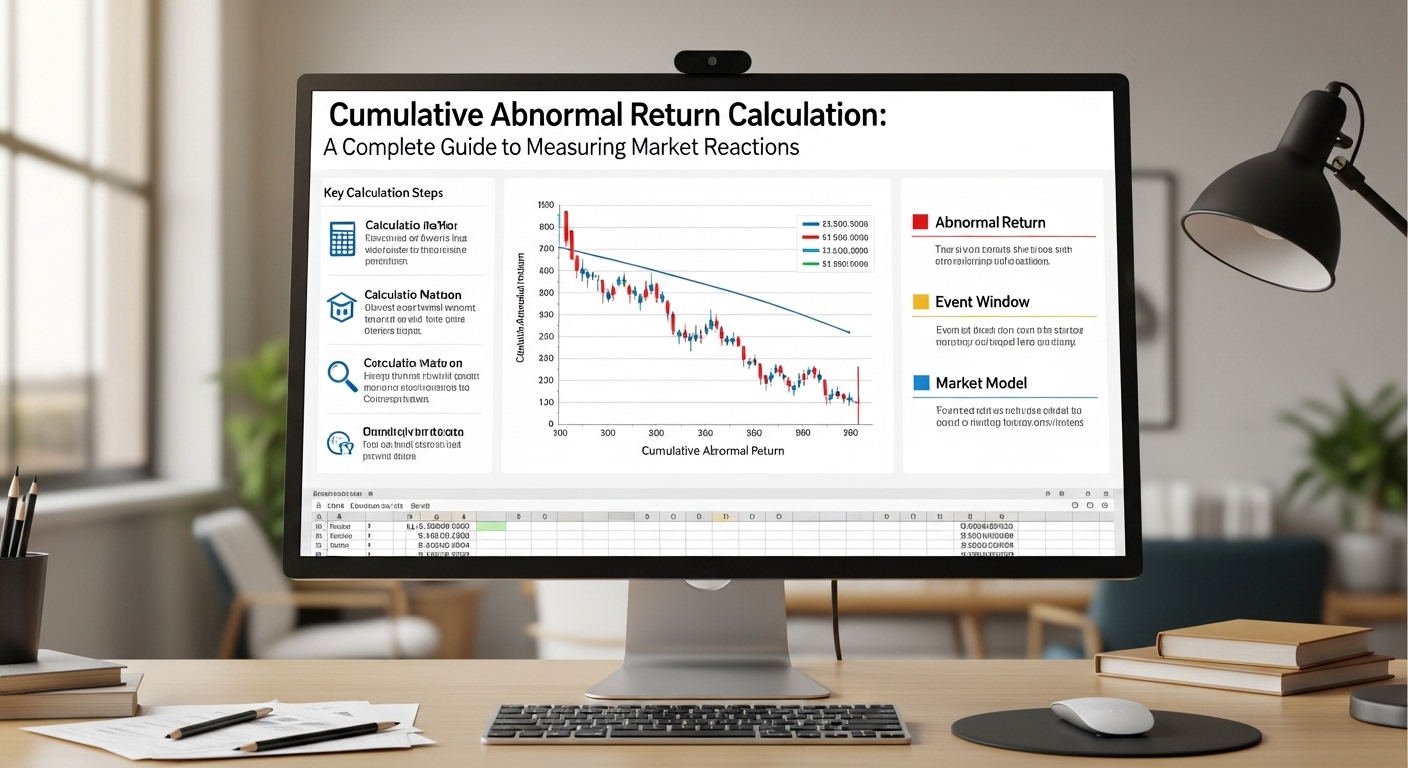
Financial markets react constantly to new information. When companies release earnings reports, announce mergers, or experience major events, stock prices often respond quickly. Investors and researchers frequently want to measure how these events affect stock performance. One of the most widely used methods for doing this is the cumulative abnormal return calculation.
The cumulative abnormal return calculation helps analysts determine whether a stock performed better or worse than expected during a specific period. By comparing the actual return of a stock to its expected or normal return, researchers can identify the abnormal portion of the return that might be linked to a particular event.
This concept is commonly used in financial research, event studies, corporate finance, and investment analysis. Understanding how cumulative abnormal returns work allows investors and analysts to interpret market reactions more accurately and evaluate whether specific events truly create value for shareholders.
Understanding Stock Returns
Before exploring the cumulative abnormal return calculation, it is important to understand what stock returns are.
A stock return represents the change in the price of a stock over a specific period. Returns can also include dividends paid to shareholders during that time.
The basic formula for calculating stock return is:
Return = (Current Price − Previous Price) / Previous Price
For example, if a stock price rises from $100 to $110, the return would be:
(110 − 100) / 100 = 0.10 or 10%
Returns allow investors to measure how well a stock has performed. However, simply observing returns is not enough to determine whether a stock performed unusually well or poorly relative to market expectations.
This is where abnormal returns come into play.
What Is an Abnormal Return?
An abnormal return represents the difference between the actual return of a stock and the expected return based on market performance or a financial model.
In simple terms:
Abnormal Return = Actual Return − Expected Return
If a company’s stock returns 8% during a period when the expected return was 5%, the abnormal return would be 3%.
Abnormal returns indicate that something unusual may have influenced the stock price. This unusual movement could be linked to:
-
Corporate announcements
-
Mergers or acquisitions
-
Regulatory changes
-
Earnings surprises
-
Market news or rumors
Because abnormal returns highlight unexpected movements, they are extremely valuable in financial research.
What Is Cumulative Abnormal Return?
While abnormal return measures the unexpected return for a single period, researchers often want to analyze the effect of an event over multiple days.
This is where the cumulative abnormal return calculation becomes important.
Cumulative abnormal return (CAR) represents the total abnormal return over a specific time window. It is obtained by adding together abnormal returns for each period within that window.
The formula is:
CAR = Sum of Abnormal Returns over the Event Window
For example, if abnormal returns over three days are:
Day 1 = 1%
Day 2 = 2%
Day 3 = −0.5%
The cumulative abnormal return would be:
1% + 2% − 0.5% = 2.5%
The cumulative abnormal return calculation helps analysts understand the total impact of an event on stock performance.
Why Cumulative Abnormal Return Calculation Is Important
Measuring Market Reactions
One of the main uses of the cumulative abnormal return calculation is to measure how the market reacts to new information.
For example, if a company announces a major merger and its stock shows positive abnormal returns over several days, the cumulative abnormal return indicates that investors believe the merger will create value.
Evaluating Corporate Events
Researchers frequently use cumulative abnormal returns to analyze the impact of events such as:
-
Earnings announcements
-
Dividend changes
-
CEO appointments
-
Stock splits
-
Product launches
By analyzing the cumulative abnormal return calculation, researchers can determine whether these events positively or negatively affect shareholder wealth.
Supporting Financial Research
In academic finance, event studies rely heavily on cumulative abnormal returns. These studies help economists understand how quickly markets process information and whether markets behave efficiently.
Key Components of Cumulative Abnormal Return Calculation
Event Date
The event date is the specific day when the event occurs or becomes public knowledge.
For example:
-
A company announces quarterly earnings
-
A merger is officially confirmed
-
A regulatory decision is released
This date is usually labeled as Day 0 in event studies.
Event Window
The event window represents the period during which abnormal returns are measured.
Common event windows include:
-
(-1, +1) → One day before and one day after the event
-
(-5, +5) → Five days before and five days after
-
(0, +10) → Event day plus ten days after
The cumulative abnormal return calculation sums abnormal returns within this chosen window.
Estimation Window
The estimation window is used to calculate expected returns. It typically occurs before the event window.
For example, analysts may use 120 trading days before the event to estimate the relationship between a stock and the market.
This data helps build a model that predicts what the stock’s normal return should be.
Methods for Estimating Expected Returns
The accuracy of the cumulative abnormal return calculation depends on how expected returns are estimated. Several models are commonly used.
Market Model
The market model is one of the most widely used methods.
It estimates expected returns based on the relationship between a stock and a market index.
The formula is:
Expected Return = Alpha + Beta × Market Return
Where:
-
Alpha represents the stock’s average return independent of the market
-
Beta measures how sensitive the stock is to market movements
Mean Adjusted Model
This method assumes the expected return equals the historical average return of the stock.
While simple, it may not account for changes in market conditions.
Market Adjusted Model
In this approach, expected return is assumed to equal the return of the market index.
Although less precise, it is easy to apply and useful for quick analyses.
Step-by-Step Process of Cumulative Abnormal Return Calculation
Step 1: Identify the Event
First, determine the event you want to study.
Examples include:
-
Earnings announcements
-
Product launches
-
Policy changes
Step 2: Define the Event Window
Select the period during which you want to measure abnormal returns.
For instance, a (-3, +3) window includes three days before and three days after the event.
Step 3: Collect Stock Price Data
Gather historical price data for the stock and the market index.
Data is typically obtained from financial databases or stock exchanges.
Step 4: Calculate Expected Returns
Use an estimation model such as the market model to calculate expected returns during the event window.
Step 5: Calculate Abnormal Returns
Subtract expected returns from actual returns:
Abnormal Return = Actual Return − Expected Return
Step 6: Perform the Cumulative Abnormal Return Calculation
Add the abnormal returns across the event window.
This sum represents the cumulative abnormal return.
Example of Cumulative Abnormal Return Calculation
Suppose a company announces a major partnership.
The abnormal returns during the event window are:
Day -1: 0.5%
Day 0: 2%
Day +1: 1.5%
The cumulative abnormal return calculation would be:
0.5% + 2% + 1.5% = 4%
This suggests the event created a positive market reaction.
Applications in Real-World Finance
Merger and Acquisition Studies
Researchers frequently analyze cumulative abnormal returns around merger announcements.
If acquiring companies show negative CARs, investors may believe the deal is risky.
Earnings Announcements
The cumulative abnormal return calculation helps determine whether companies exceed or fall short of market expectations.
Positive CARs often occur when earnings exceed forecasts.
Corporate Governance Research
Studies often examine how leadership changes affect stock prices by measuring cumulative abnormal returns around CEO announcements.
Limitations of Cumulative Abnormal Return Calculation
Model Assumptions
Expected return models rely on assumptions that may not always reflect real market behavior.
Market Noise
Stock prices move for many reasons, not just the event being studied.
This can affect the accuracy of the cumulative abnormal return calculation.
Event Overlap
If multiple events occur around the same time, it becomes difficult to isolate the impact of a single event.
Best Practices for Accurate Analysis
To improve accuracy, analysts should:
-
Use reliable financial data
-
Select appropriate event windows
-
Apply robust statistical methods
-
Consider alternative models for expected returns
These steps strengthen the reliability of the cumulative abnormal return calculation.
The Role of Cumulative Abnormal Returns in Modern Finance
Cumulative abnormal returns remain a powerful tool for understanding financial markets.
They allow analysts to measure how quickly information is reflected in stock prices and whether markets respond rationally to new developments.
From academic research to investment strategies, the cumulative abnormal return calculation provides valuable insights into how events influence shareholder value.
Conclusion
Financial markets are constantly reacting to new information, and understanding those reactions is essential for investors and researchers. The cumulative abnormal return calculation offers a systematic way to measure how specific events influence stock prices over time.
By comparing actual returns to expected returns and summing the differences across an event window, analysts can determine whether an event creates positive or negative value for shareholders.
Although the method has certain limitations, it remains one of the most widely used techniques in financial research and event studies. When applied carefully, the cumulative abnormal return calculation can reveal meaningful insights about market behavior, investor expectations, and the impact of corporate decisions.