
 By admin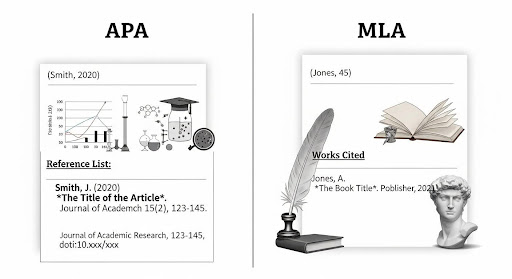
Citation styles are essential in academic writing because they help give proper credit to original authors and maintain consistency in research papers. Among the most widely used citation systems are APA and MLA. Understanding the differences between these two formats is important for students, researchers, and academic writers. Many students preparing for challenging academic tasks, such as My Proctored Finance Exam, often need to follow specific citation guidelines depending on the subject and institution.
In this article, we’ll explore the key differences between APA and MLA citation styles, including their formats, usage, structure, and examples.
What Is APA Citation Style?
APA (American Psychological Association) citation style is primarily used in the social sciences. It is commonly applied in fields such as psychology, education, sociology, and business studies.
APA style focuses on the author and publication date, which helps readers quickly identify how recent the research is. Because scientific research often relies on current findings, the publication year is an important element in APA citations.
Key Features of APA Style
- Uses author–date citation format
- Includes the publication year in in-text citations
- Uses a reference list at the end of the document
- Emphasizes recent sources
- Commonly used in social sciences and scientific research
Example of APA In-Text Citation
Example:
(Smith, 2022)
Example of APA Reference
Smith, J. (2022). Understanding digital marketing trends. New York: Academic Press.
What Is MLA Citation Style?
MLA (Modern Language Association) citation style is commonly used in the humanities. It is widely applied in subjects such as literature, philosophy, cultural studies, and language research.
Unlike APA, MLA focuses more on the author and page number rather than the publication year. This approach is useful in humanities research where scholars frequently reference specific passages or quotes from books and texts.
Key Features of MLA Style
- Uses author–page citation format
- Does not emphasize publication year
- Includes a Works Cited page
- Often used for literature and humanities research
- Focuses on exact text references
Example of MLA In-Text Citation
Example:
(Smith 45)
Example of MLA Works Cited Entry
Smith, John. Understanding Digital Marketing Trends. Academic Press, 2022.
Major Differences Between APA and MLA Citation Styles
Although both citation styles aim to credit sources properly, they differ in several important ways.
1. Subject Areas
One of the most noticeable differences between APA and MLA citation styles is the academic fields where they are used.
APA Style
Used mainly in:
- Psychology
- Sociology
- Education
- Business
- Social sciences
MLA Style
Commonly used in:
- Literature
- Language studies
- Cultural studies
- Humanities
The choice of citation style usually depends on the academic discipline or the instructor’s requirements.
2. In-Text Citation Format
Another major difference is the structure of in-text citations.
APA Citation Example
(Johnson, 2021)
APA includes the author’s last name and the publication year.
MLA Citation Example
(Johnson 76)
MLA includes the author’s last name and the page number, but not the publication year.
3. Reference List vs Works Cited
APA and MLA also use different names and formats for their source lists.
APA
- Uses a Reference List
- Includes the publication year after the author’s name
Example:
Johnson, M. (2021). Marketing in the digital age. Oxford University Press.
MLA
- Uses a Works Cited page
- The publication year appears later in the citation
Example:
Johnson, Mark. Marketing in the Digital Age. Oxford University Press, 2021.
4. Title Formatting
APA and MLA also differ in how titles are formatted.
APA Style
- Uses sentence case for titles
- Only the first word and proper nouns are capitalized
Example:
The impact of social media on business growth
MLA Style
- Uses title case
- Major words are capitalized
Example:
The Impact of Social Media on Business Growth
5. Author Name Format
The formatting of author names also varies.
APA
- Uses initials for first and middle names
Example:
Smith, J. A.
MLA
- Uses full first name
Example:
Smith, John A.
6. Running Head and Title Page
APA requires additional formatting elements that MLA typically does not.
APA Format Includes
- Title page
- Running head
- Abstract (in some papers)
MLA Format Includes
- No title page in most cases
- Author name, instructor, course, and date at the top of the first page
APA vs MLA: Quick Comparison Table
| Feature | APA Style | MLA Style |
| Common Fields | Social sciences | Humanities |
| In-Text Citation | Author + Year | Author + Page number |
| Source List | Reference List | Works Cited |
| Title Format | Sentence case | Title case |
| Author Names | Initials | Full first name |
| Publication Year | Important | Less emphasized |
When to Use APA or MLA Citation Style
Choosing the correct citation style depends on several factors.
Use APA When:
- Writing research papers in psychology or social sciences
- Conducting scientific research
- Referencing recent studies or data
Use MLA When:
- Writing literature essays
- Analyzing books or poems
- Working in humanities or language subjects
Students should always check their institution’s guidelines to determine which citation format is required.
Why Citation Styles Matter in Academic Writing
Citation styles are more than just formatting rules. They play an important role in maintaining academic integrity.
Proper citations help:
- Avoid plagiarism
- Credit original authors
- Support research arguments
- Improve credibility of academic work
Using the correct citation style also helps readers locate the original sources used in the research.
Conclusion
Understanding the differences between APA and MLA citation styles is essential for academic success. While APA focuses on the author and publication year and is widely used in social sciences, MLA emphasizes the author and page number and is commonly applied in humanities research. Both citation styles provide structured ways to reference sources and ensure proper academic attribution.
Students and researchers who follow the correct citation guidelines can produce more credible and professional academic work. For additional academic support, writing guidance, and research assistance, platforms like ScholarlyHelp can help learners navigate complex academic requirements and improve their scholarly writing skills.